
As an interdisciplinary field concerned with conceptions and transformations of nature, environmental history has always had a vexed relationship with the discipline of ecology. William Cronon’s battle with Clementsian climax theory in his pathbreaking Changes in the Land (1983) is an early example. Through deep historical research into the New England landscape, he helped demonstrate that the stable climax communities envisioned by Frederic Clements in the early twentieth century were fanciful or ephemeral, though Cronon himself struggled to escape the paradigm. Environmental historians continue to draw on and problematize ecological concepts, and this paper makes a case for engaging with yet another ecological theory: meta-ecosystems.1
This concept arose in the early 2000s from two related ideas. The first, metapopulations, emerged in island biogeography in the 1960s and 1970s to explain how spatial coupling allowed species to persist regionally despite local extinctions. The second, metacommunities, developed in landscape ecology at the turn of the century to describe local biotic communities linked by exchanges across landscapes and regions. The notion of a meta-ecosystem takes this further to include non-biotic nutrient and energy transfers. It is, to quote Michel Loreau, “a set of ecosystems connected by spatial flows of energy, materials, and organisms across ecosystem boundaries.” According to Loreau, these nutrient flows can shape the structure and functions of dispersed ecosystems, with deductions from one representing inputs to another. Identifying these exchanges helps illustrate how ecosystems operate at local, regional, and global scales. Such studies are also critical for developing a fuller understanding of the broad ramifications of anthropogenic environmental change.2
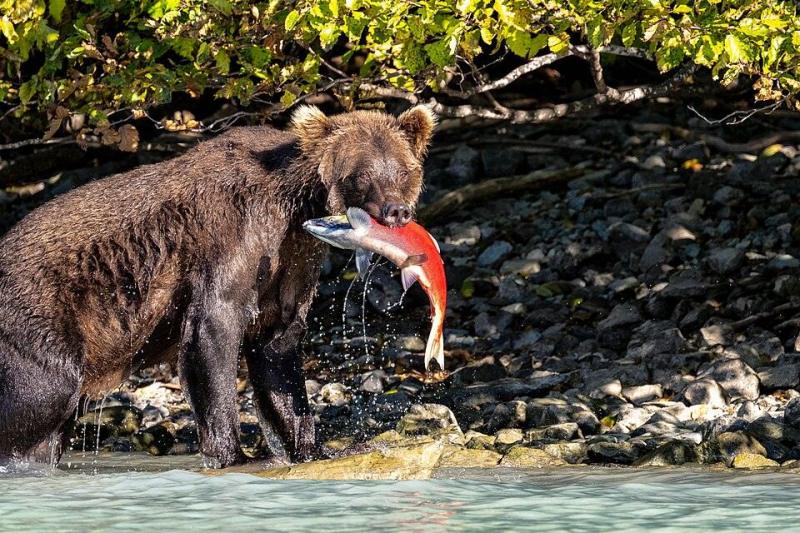
What does this look like in practice? Scientists have traced multiple nutrient flows that suggest the existence of meta-ecosystems. The life cycle of Pacific salmon is a prime example. Each year, millions of anadromous members of the Oncorhynchus genus return to their natal streams to spawn and die. Because salmon feed for years at sea, their heaped carcasses constitute significant transfers of nitrogen and other nutrients from marine to riparian ecosystems. Predators and scavengers then feast on the dead fish and further redistribute nutrients as scraps and excreta into an ever expanding geography of subsidies. Using nitrogen signatures, tree ring analysis, and other proxy data, researchers have traced this nitrogen pulse, documenting how salmon bodies contribute to the abundance, health, and diversity of conifers, wildflowers, insects, birds, predators, and scavengers. These findings have generated interest among researchers and laypeople alike. Woods in western Canada and the United States have earned the moniker of “Salmon Forests.” 3
What could historians contribute to this conversation? By writing what we might call meta-ecosystem histories, we can reveal how nutrient flows shaped the course of human history, and how human activities reshaped these meta-ecosystems. For inspiration, we could turn to Bathsheba Demuth’s superb discussion of Arctic energy flows in her extraordinary Floating Coast (2019). Extended back into deep time, this endeavour could also include a component of what Edmund Russell has termed evolutionary history, tracing how anthropogenic evolution transformed the genetic stock of salmon and other vectors. Meta-ecosystem histories can redefine the scales of historical analysis to identify previously overlooked geographic and temporal connections, reinvigorate well-studied topics, and reveal new dimensions to some of the field’s richest themes.4
Environmental historians have spent decades examining the topic of North American Pacific salmon, producing some of the field’s most celebrated works. Key volumes include Arthur McEvoy’s The Fisherman’s Problem (1986), Richard White’s The Organic Machine (1995), Jay Taylor’s Making Salmon (1999), Douglas Harris’s Fish, Law, and Colonialism (2001), Matthew Evenden’s Fish versus Power (2004), David Arnold’s The Fishermen’s Frontier (2008), and Lissa Wadewitz’s The Nature of Borders (2012). These outstanding studies provide keen insights into how salmon shaped regional history, even as humans profoundly reshaped salmon environments, abundance, range, behaviour, and genetics. They have analysed Pacific salmon’s role in the emergence of wealthy, hierarchical Indigenous populations, each with claims to harvest zones; the (often disastrous) transition from Indigenous stewardship to state-managed industrial fisheries; settler disruption of salmon ecology through mining, agriculture, urbanization, industrialization, and dams; and the environmental and social challenges accompanying technological panaceas like hatcheries and fish farms. Even in a discipline that emphasizes constant re-examination and revision, one could be forgiven for thinking this topic is somewhat fished out.5

By re-examining this theme through the lens of meta-ecosystem history, fresh insights emerge. Pacific Northwest Indigenous groups such as the numerous Coast Salish Peoples of present-day British Columbia, Washington, and Oregon made salmon a staple of their diet and a cornerstone of their culture, yet meta-ecosystem analyses reveal that humans were in fact late-comers to the feast.6 The region’s forests had incorporated salmon nutrients millennia earlier. Northwest Coast Indigenous groups thus drew upon a larder that included not just salmon but an enriched ecosystem of Western Red Cedar (a rot-resistant building material for longhouses and canoes), salmon berries (a food source with other parts of the plant having medicinal uses), and bears (hunted for food and hides). Research has shown that all these species benefitted from robust salmon runs. Thinking in terms of meta-ecosystems, we can also consider how sustainable Indigenous salmon harvests helped stabilize marine ecosystems extending hundreds and even thousands of kilometres offshore, where salmon built their mass in the broader food web.
Producing meta-ecosystem histories will require collaboration with ecologists and biologists. In turn, historians can provide insights into how meta-ecosystems have changed over time through human and non-human forces. A clear starting point would be to overlap archival data on historical fishing pressure and anthropogenic landscape change with tree-ring analysis and other evidence tracing salmon subsidies diachronically. Historical dam building, which often completely blocked salmon from ancient spawning sites, offers a clear opportunity for using dendrochronology to compare conifer growth in forests in the presence and absence of this influx.7
When we recognize that salmon runs created ecological and economic values extending across terrestrial, riverine, and marine ecosystems, the transition from Indigenous fisheries to state-managed industrial harvests takes on greater import. The generally successful Indigenous stewardship of salmon not only maintained an annual return of abundant protein, fat, and vitamins but it also helped to preserve the wider ecological community upon which Indigenous communities relied. State management in Canada and the US, which oversaw massive declines in salmon runs on large and small streams alike, had deleterious effects that ramified outwards into terrestrial and marine ecologies and the people who relied on them for subsistence and livelihood.8

Viewing these changes through meta-ecosystem analysis, we might perceive a variant of ecological imperialism at play in which settlers have replaced one Pacific salmon meta-ecosystem, in which the nutrient flow depended upon and benefited Indigenous peoples, with another intended to serve industrial capitalist settler societies. These flows link human and ecological communities across thousands of kilometres of land and sea. To a much greater extent than today, the former system enriched inland riparian ecosystems with nutrient subsidies that benefited plants, animals, and the peoples who depended upon them. These salmon forests endured for millennia. The current system, by contrast, features depleted salmon runs and starved salmon forests. Because farmed salmon only spawn in rivers when they escape their pens, they add minimal nutrients to inland ecologies. Indeed, farmed salmon’s pellet-based diets, now increasingly plant-sourced, effectively reverse the nutrient flow from land to sea. Perceived in these terms, restoring Indigenous rights and sovereignty requires not only recognizing their role in managing and harvesting salmon but also reestablishing this disrupted Pacific Northwest meta-ecosystem.9
Pacific salmon help to illustrate the notion of a meta-ecosystem history, but many other topics lend themselves to similar analysis. Seabirds gather nutrients across vast swaths of oceanic territory before redistributing this energy onshore in the form of bodies, scraps, and guano. This has sometimes constituted the primary nitrogen input to otherwise resource-scarce ecosystems. It also facilitated the fertilizer boom that Gregory Cushman masterfully described in Guano and the Opening of the Pacific World (2013). How did industrial fishing, habitat destruction, and invasive species—which have contributed to nearly 40-percent of seabird species now being threatened—disrupt and redirect this system? Meta-ecosystem analysis enables narratives that exemplify the ideal of thinking locally and globally, and of seamlessly melding human and non-human communities.10
- William Cronon, Changes in the Land (Hill and Wang, 2003 [1983]), 10, 32-33; William Cronon, “In Search of Nature” in William Cronon, ed., Uncommon Ground (W. W. Norton and Co., 1995), 24; Richard White, “Environmental History: Watching a Historical Field Mature,” PHR 70 (February 2001), 106.[↩]
- Michel Loreau, et al., “Meta-ecosystems” Ecology Letters 6 (2003), 673-675; Daniel Schindler and Adrianne Smits, “Subsidies of Aquatic Resources in Terrestrial Ecosystems” Ecosystems 20 (2016), 78.[↩]
- Allison Dennert, et al., “Experimental addition of marine-derived nutrients affects wildflower traits in a coastal meta-ecosystem”Royal Society Open Science 10 (2023), 1-2, 9; Thomas Reimchen and Caroline Fox, “Fine-scale spatiotemporal influences of salmon on growth and nitrogen signatures of Sitka spruce tree rings” Ecology 13(38) (2013): 1-13; Schindler and Smits, “Subsidies of Aquatic Resources,” 78; Gary Polis and Stephen Hurd, “Linking Marine and Terrestrial Food Webs” The American Naturalist 147(3) (March 1996), 396;Christy Morrissey, et al., “American Dippers Indicate Contaminant Biotransport by Pacific Salmon” Environmental Science and Technology 46 (2012): 1153-1162; Schindler and Smits, “Subsidies of Aquatic Resources,” 78; Thomas Reimchen, “The carcass zone: salmon contribution to tree rings in old-growth Sitka Spruce (Picea sitchensis)” The Canadian Field-Naturalist 138 (2024): 145-162; Dennert, et al., “Experimental addition of marine-derived nutrients,” 1-2, 9; Reimchen and Fox, “Fine-scale spatiotemporal influences,” 1-13; Loreau, et al., “Meta-ecosystems,” 673-675.[↩]
- Edmund Russell, Evolutionary History: Uniting History and Biology to Understand Life on Earth (Cambridge University Press, 2011), 145-149; Bathsheba Demuth, Floating Coast: An Environmental History of the Bering Strait (W. W. Norton and Co, 2019), 4-10.[↩]
- Arthur McEvoy, The Fisherman’s Problem: Ecology and Law in the California Fisheries, 1850-1980 (Cambridge University Press, 1986), 21, 135; Richard White, The Organic Machine: The Remaking of the Columbia River (Hill and Wang, 1995), ix; Joseph Taylor, Making Salmon: An Environmental History of the Northwest Fisheries Crisis (University of Washington Press, 1999), 14, 56-59, 68; Douglas Harris, Fish, Law, and Colonialism: The Legal Capture of Salmon in British Columbia (University of Toronto Press, 2001); Mathew Evenden, Fish versus Power: An Environmental History of the Fraser River (Cambridge University Press, 2004), 3, 19-21; David Arnold, The Fishermen’s Frontier: People and Salmon in Southeast Alaska (University of Washington Press, 2008), 36; Lissa Wadewitz, The Nature of Borders: Salmon, Boundaries, and Bandits on the Salish Sea (UBC Press, 2012), 20. For how the remaking of Seattle’s waterfront and river systems impacted salmon populations, see Matthew Klingle, The Emerald City: An Environmental History of Seattle (Yale University Press, 2009) [↩]
- Specific Coast Salish groups with extensive salmon fisheries include for instance Dxʷdəwʔabš (Duwamish), Lhaq’temish (Lummi), Quwʼutsun (Cowichan), Sḵwx̱wú7mesh (Squamish), Stó:lō, xʷməθkʷəy̓əm (Musqueam), Nisqually, and many others.[↩]
- L. D Siemens, et al., “Spawning salmon density influences fruit production of salmonberry (Rubus spectabilis)” Ecosphere 11(11) (2020): e03282; J.W.H. Connoy, et al., “Studying Chinook salmon in northern river ecosystems through ecological methods and Indigenous, Teslin Tlingit knowledge” Communications Biology 7 (2024): 1657[↩]
- Stephen Bocking, “Science, Salmon, and Sea Lice” J. Hist. Biol. 45(4) (Winter 2012): 681-716; Miles Powell, “Divided Waters: Heiltsuk Spatial Management of Herring Fisheries and the Politics of Native Sovereignty” WHQ 43 (4) (2012): 463–84.[↩]
- A. W. Crosby, Ecological Imperialism. 2. Ed. (Cambridge Univ. Press, 2009) [↩]
- Gregory Cushman, Guano and the Opening of the Pacific World (Cambridge University Press, 2013); Polis and Hurd, “Linking Marine and Terrestrial Food Webs,” 397; Jennifer Sills, “Seabirds: Sentinels beyond the oceans” Science 366(6467) (15 November 2019), 813.[↩]


